I.The rules of the game
We will start our journey through Dutch political history by taking
a look at how the political game is being played right now. There are a myriad of
rules, some written down in the constitution, others unwritten law, and you have to
have a general idea of how things work.
Monarchy

Willem-Alexander, King of the Netherlands 2013-present, with his wife, Queen Maxima.
The eldest child of the King or Queen, whether male or female, inherits the crown, unless he or she
relinquishes that right, most commonly by marrying without parliamentary approval.
The King’s great-grandmother, grandmother and mother, Queens Wilhelmina (1890-1948), Juliana (1948-1980), and Beatrix (1980-2013)
voluntarily abdicated the throne around their 70th birthday.
The Kingdom of the Netherlands is a constitutional monarchy whose crown is heriditary in the House
of Orange-Nassau. Current head of state is King Willem-Alexander. (Incidentally, we’ve had female heads
of State from 1890 to 2013. A dynastic accident, but still, I think, a world record.)
Formally the King appoints the prime minister and the government, but since the 1880s or so it has been custom
that this government has a majority in parliament.
In practice the King wields little power. How much her personal opinions matter is not known; in fact,
how much influence she has is one of the few remaining palace secrets, and those important politicians who know
are not allowed to publish such facts.
She only participates actively in politics just after the elections, when a new government is being
formed. She appoints the politicians who take the lead in this process, and she replaces them
by others if that becomes necessary.
In general the politicians are able to finish the process by themselves, but occasionally they need some
nudging; and that’s the King’s job. He can also creatively bend the rules of government formation
if that becomes necessary. We’ll study the 1994 formation in detail, when Queen Beatrix’s role was more active
than usual.
In general, former Queen Beatrix was considered a very capable, very organised manager, and partly due to her
unquestioned ability, anti-monarchical sentiment is essentially nil. Even the SP (Socialist Party;
extreme left) officially abandoned its republican stance in 2006. So far, King Willem-Alexander has inherited this
goodwill from his mother.
Capital and seat of government
Amsterdam is the capital of the Netherlands; the constitution says so. However, the government seat is Den Haag (The Hague).
In the Middle Ages, Den Haag functioned as the capital of the medieval county of Holland. Back
then, Amsterdam and the five other large towns did not allow each other to function as seat of government, and besides the
Count wanted to stress his independence of the six towns (who held the purse strings anyway). That was why Den
Haag, originally a country mansion of the Count, gradually developed into the political capital.
When the United Provinces were formed in 1579, Holland was by far the most powerful of the seven provinces,
and therefore its capital became the national capital, too.
Since the 1590s Amsterdam has been the wealthiest, most populous, and best known city of the Netherlands,
and therefore it became the capital. (It took until 1983 to actually put this in the constitution).
Government (as well as the Royal family) stayed in Den Haag, though.
Because Amsterdam is the official, constitutional capital, the Kings and Queens are sworn into office
there (Dutch monarchy doesn’t use coronation), and foreign heads of state are received there. Other
than that it hosts no government functions.
In fact, Amsterdam isn’t even allowed to host the provincial government of Noord-Holland, which resides
in Haarlem.
Changing the constitution
Changing the Dutch constitution is a multi-part effort:
- First, a proposal for constitutional change is made into normal law. The law should
states that parliament considers changing the constitution, and exactly in which way.
- If this law is passed by a normal majority in parliament, parliament is disbanded and
new elections are held.
- Both chambers of the new parliament now consider the proposed constitutional change,
and the change must be passed by a two-thirds majority.
The idea is to give the voters a chance to refuse the proposed change by voting for
parties who declare against it.
Usually constitutional changes are timed to coincide with normal elections. Only the
1948 parliament was elected especially to agree to the change in the constitution
required by Indonesia becoming independent.
Elections
The Dutch voters elect only their legislative assemblies. All executive office holders are
appointed theoretically by the King; in practice by complicated negotiations between the larger parties.
Proportional representation
Centrist D66 is the most outspoken proponent of a district system, because that would enhance the direct
ties between voters and MPs. Of course, under such a system D66 itself would lose all its seats in parliament.
The Netherlands do not have electoral districts, as the US and UK do. Instead,
a party enters parliament by getting enough votes for at least one seat.
National parliament consists of 150 members, so 0.66%, or 65,000 of the slightly less than 10
million votes is enough to win one seat. Where these votes were cast does not matter.
In a district system we’d probably have only two parties: CDA and PvdA. This prospect is too
boring to be contemplated, and therefore attempts to introduce the district system are doomed to failure.
Parties and party lists
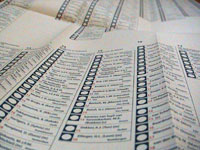
A Dutch ballot form. The columns are party lists. The voter votes for a candidate by colouring
the circle before his or her name red.
During elections one votes for a person, and in theory MPs are elected on a personal basis. In
practice the vote goes to a party, or rather to a party list.
Before the elections, each party that wishes to participate hands in a list of candidates. It’s these
lists of candidates that appear on the ballot, and every voter is allowed to select one candidate.
Most of the party candidates are unknown to the general public, and therefore most people vote for the
first person on the list of their party of choice. This first person is always the party leader,
who in general gets about 70 to 90% of all the votes for his (rarely her) party.
The total number of votes for all candidates of one list determines how many seats that list gets.
The party list system has advantages as well as disadvantages. The most obvious disadvantage is that
few MPs are generally known throughout the country; most are rather anonymous party members that wouldn’t have
been elected if they hadn’t been on the party list and are therefore beholden to the party bosses,
and not to the voters.
The advantage is that parties can get their specialists into parliament. Every party has a few MPs who
sorely lack charisma and would never be elected on their own, but who also have excellent knowledge of a
specialised field; say Education or Finance. In order to keep these specialists in parliament they’re
usually placed highly on the party list.
If an MP dies or leaves parliament, the party nominates the first candidate on the original list that
was not elected. After all, it was this party list that the voters originally voted for, and their wish has
to be respected. When this candidate refuses the seat, the next candidate is nominated.
The States-General
The States-General (plural) are the Dutch parliament, and they have a venerable pedigree reaching
back to 1464.
The States-General are divided in two houses: the First Chamber or Senate with 75 seats, elected by
the provincial States, and the Second Chamber with 150 seats, elected directly by the people. Of the two
the Second Chamber is by far the most important; and it’s to this Chamber I refer when I say “parliament.”
Second Chamber
The combination of personal membership of parliament and the party list system can have curious
consequences.
In the 2003 elections, the LPF won eight seats. The eighth candidate on the party list was Gonny
van Oudenallen, but she was ousted by lower-placed Hilbrand Nawijn through preferential votes (see below).
Nawijn left the party in 2005 to found his own. Since he was an MP on personal title, he kept his seat.
Then LPF MP Margot Kraneveldt converted to the PvdA. Although she, too, could have kept her
seat she did the proper thing by leaving parliament and returning her seat to the LPF.
The LPF needed a new MP, and Van Oudenallen was the highest unelected member of the original party
list. By that time, however, she’d been caught up in an affair concerning subsidies to her former
party for which she’d been elected to the Amsterdam city council.
The LPF did not want her in the
fraction, but was still forced to offer her the empty seat. She entered parliament as Group Van Oudenallen,
and left it again when it was disbanded six months later. Her tenure as MP, however brief and ridiculous,
entitles her to the quite generous discharge payments for members of parliament.
The LPF lost two more members before its sad and sorry end. One joined Nawijn, and the other, Eerdmans,
founded his own EenNL party. Both stayed in parliament; Eerdmans even recruited a dissident VVD MP
for his party.
After the 2006 elections, none of these parties and groups returned to parliament. Instead, all these
seats, including the one from the VVD dissident, went to Wilders’s PVV.
Moral: vet your candidates.
This series of splits was considered excessive even by Dutch standards.
It’s in the Second Chamber that all the political action takes place, and it’s the elections for this
Chamber that are decisive for the political future of the country. It has 150 members.
Before 2002 the largest party appointed the chair of parliament from its midst. In
2002 this rule was changed to an election by parliament as a whole.
MPs are organised by party; all MPs from one party are called a fraction. All fractions elect a
chairman, and it’s this chairman that is usually considered the party leader, except for coalition
parties, whose leaders usually move on to government.
The Second Chamber has numerous committees and sub-committees. Seats on these committees are divided
according to the relative strength of the various parties.
Despite being organised by party, MPs sit on personal title, and they may decide to leave their party
and continue as an independent MP, (or even enter another party, but that almost never happens).
Since most MPs are quite unknown to the general public, such Independents are usually not re-elected.
The most important exception to this rule is the gradual erosion of the VVD’s right wing.
In 2004 Geert Wilders, a right-wing VVD MP became an Independent, founded his own party, and returned to parliament
with 9 seats after the 2006 elections. In 2007, right-winger Rita Verdonk staged an unsuccesful coup
against centrist party leader Mark Rutte, and during the aftermath she was expelled from the party.
Since then she’s an Independent, too, and she hopes to follow Wilders’ electoral example. (Of course,
the two compete for the same voters.)
Most “dissident” MPs return to obscurity after the next elections, though.
First Chamber
The First Chamber or Senate is elected by the provincial States (parliaments) directly after the provincial
elections. Being a senator is less demanding than being in the Second Chamber; the Senate sits for only
two or three days per week, allowing members to simultaneously pursue other careers. This is considered a Good
Thing, since it allows senators, more than Second Chamber MPs, to keep in touch with society in general.
The Senate has 75 members.
In theory, the Senate can only approve or reject proposals; it cannot amend them. In practice, though, government
or the Second Chamber reacts to problems in the Senate by slightly changing the proposals.
In general, the Senate as a whole and individual senators act somewhat more independent than Second
Chamber MPs. Nonetheless, proposals that are passed by the Second Chamber but rejected by the Senate
are rare, and such an occurrence usually causes quite a stir.
The Senate is best typified by CDA senatorial leader Kaland in the eigthies. He was a critic of
CDA prime minister Lubbers, and was wont to hold impassioned speeches with detailed criticism
of government-proposed laws. However, he always ended these speeches by noting he would of course vote in
favour of the law.
After every Senate election, people wonder whether the Senate still fulfills an important role in
Dutch politics, and some propose to abolish it. Although usually a few politicians make sympathetic
noises, nothing is ever actually done.
Dualism
Formally, the Dutch system is a dual one that pits government against parliament. Ministers and secretaries
of state are not members of parliament, and formally the MPs of the various coalition partners are supposed
to check government actions without paying attention to the fact that members of their party happen to be
ministers.
In practice, party discipline is quite severe (except on the extreme right), and coalition party MPs usually
follow the government. That makes government more important than parliament, which in turn means that
party leaders usually opt for a ministry instead of a seat in parliament.
However, the idea of the party leader remaining in parliament to check government is not entirely dead.
Most parties make appreciative noises from time to time and agree that it would help dualism along, and
right-wing VVD even occasionally brings theory into practice.
Government
The King appoints a prime minister and other cabinet ministers. These ministers unfailingly come from
the current coalition parties, which have a majority in parliament and have agreed to cooperate during
government formation.
The usual term of a parliament (and thus a government) is four years. After that time, new elections are
held and a new government is formed. However, new elections may also occur when a government falls (see below).
Prime minister and vice prime ministers
The prime minister always comes from the largest party in the coalition (usually CDA or PvdA).
In addition, each other coalition party nominates its party leader as vice prime minister; this is largely
an honorary title, although a vice prime minister may occasionally take decisions instead of the
prime minister.
The prime minister has no formal powers; he cannot fire other ministers or force them to do
something against their will. The prime minister rules by grace of his authority, and if he doesn’t
have that much authority to begin with, government may become unstable. (This is the besetting
sin of prime minister Balkenende (CDA).)
Name
The government is known by the prime minister’s name; followed by a Roman numeral if it’s his second
or later government. After the 2006 elections the the Balkenende IV government was formed; i.e. the fourth
government prime minister Balkenende (CDA) has presided over.
Ministers and departments
2008 departments
- General Affairs (prime minister’s office)
- Interior
- Foreign Affairs
- Defense
- Economic Affairs
- Finance
- Justice
- Agriculture
- Education and culture
- Social Affairs
- Traffic and Waterstate
- Health
- Housing and Environment
The department of Waterstate is responsible for maintenance of the water works; obviously
a supremely important task in a country whose most densely populated areas are centimeters above or
slightly below sea level.
Obviously, during government formation the amount and nature of the departments reserved for each
of the coalition parties is the hottest item under discussion.
There’s one sacred rule: the division of ministers in government should mirror the parties’ relative
strength in the government coalition in parliament. The more seats you have, the more ministers you get.
The number of departments is currently fixed at thirteen. Gradual changes may occur, but the current
division is logical and unlikely to change hugely.
The actual number of ministers is somewhat larger than thirteen.
There is always minister for Development Relations, but such a department does not exist.
Frequently, small coalition
parties demand a special “programme minister” who will coordinate policy on that party’s pet project.
Having a programme minister is important to the small parties — they are usually overwhelmed by their
large coalition partners when it comes to media attention, but pushing their pet projects through government and
parliament helps them retain part of their visibility (and voters).
In the Balkenende IV government, CU party leader Rouvoet is
minister for Youth and Family Affairs, a typical programme ministry catering to the CU’s christian focus on
the family as the cornerstone of society. Similarly, D66 used to have a programme minister focusing on
making government more democratic, this project being the “crown jewel” of the centrist-left party.
All these supernumerary ministers get their budget and personnel from one or more of the existing departments.
The details are decided on during government formation.
Secretaries of state
In addition to ministers, there are also secretaries of state, who are a kind of assistant-ministers and who
are usually delegated part of a minister’s responsibilities. Their numbers vary wildly; although in general
most departments have zero or only one secretary of state, Education, in particular, commonly has two or three . In general
there are slightly less secretaries of state than ministers.
To make it more complicated, secretaries of state that frequently travel abroad (Foreign Trade and European
Affairs, most importantly) are allowed to present themselves as ministers to a foreign, but not to a Dutch, audience.
Most parties occasionally make noises about decreasing the
number of secretaries of state, but these posts are so useful as political small change during government
formation that they’ll likely continue to exist in their current numbers.
Once parliament has been elected, a new government has to be formed, and the parties start to negotiate on a
new coalition. The voters have no influence on these negotiations: they delivered their verdict through the ballot,
and politicians are entrusted with the sordid details that follow.
Translation note: “informateur” and “formateur” probably ought to be
translated as “informator” and “formator,” but I like informer and former better.
In the nineteenth century the King would request mr. Such-and-So to form a government, of which he would
become the prime minister. The “former” would invite his political friends to have dinner
with him to divide the ministries, and that was pretty much that.
This system continued well into the twentieth century, but especially during the Interbellum
formers would commonly fail to do their job due to the intransigeance of the parties, especially
the catholics. The Queen would appoint former after former until one of them got the job done.
The problem was that this process made the former and future prime minister lose face.
Could someone who failed in his forming have a further political career, especially when
the formership became so important that only party leaders were appointed? The party leaders
themselves preferred another solution.
When the Drees I government fell in 1951, the Queen appointed VVD luminary Stikker not former,
but “informer.” His job was to inform himself whether government could be restored,
and if so, on which conditions. A chaotic situation ensued, in which PvdA and KVP luminaries tried
to do a similar job. Eventually the Drees II government, consisting of the same parties as
Drees I, was formed.
The point was that Drees was named former only after the various informers had reached a basic
agreement with the parties, and his job had been restricted to actually nominating ministers.
This system has been used ever since.
Until 2012, the Queen appointed an informer, usually an elder statesman from the largest party,
to lead the actual negotiations. Thus the largest party’s leader (and likely future prime
minister) can enter the negotiations as party leader, and not as impartial chairman. This has
helped the political process considerably.
It’s only after the informer delivered his final report that the Queen appoints the
leader of the largest coalition party former. The former then selects the ministers, usually
within one to two weeks, and a new government is formed.
The role of the Queen
This whole series of moves is considered a weak spot in the constitution: the informer and former are
responsible to the Queen, and not to parliament. During every government formation somebody proposes to
relieve the Queen of her last bit of power and have the former elected by parliament, or even the people.
The practical problems are smaller than the theoretical ones. Usually the Queen follows the advice of the
politicians, who (are supposed to) have democratic legitimacy.
Only in very rare circumstances does she diverge from the politicians’ advice. This usually happens
when none of the potential coalition partners want to move from the positions they’ve
taken and no progress is being made. In such cases, a whispered royal word can reset the system and restart negotiations.
Defenders of the Queen’s rights see this reset role as the main argument
against changing anything in the formation process.
Later on we’ll discuss the 1994 Purple formation in detail. It includes an unusual action by the Queen.
Secrecy
The voters play no part in these complicated negotiations and are not
informed of their progress until the new government is formally announced.
There is some justification for this secrecy.
If all party leaders would constantly inform the press, and thus the voters, of their latest compromises,
all of their deeds would
be discussed (and probably reviled) by their voters, which would force the party leaders to appear intransigeant,
which in turn makes the negotiations impossible.
That happened in the 1977 negotiations, when PvdA and CDA made an effort to inform the public of their negotiations.
The PvdA had to placate its voters by hardening its position on several issues the CDA wanted it to compromise
on, and the formation failed, leading to a CDA+VVD coalition.
For roughly the same reasons, the negotiations are kept mostly secret from parliament, too. Coalition
party fractions are presented with the end result and are allowed to play with it a tiny bit.
After that they’re supposed to vote Aye and shut up.
Government formation
During the negotiations with informers and formers all political parties obey
the three sacred rules for government formation:
- The largest party takes the initiative.
- The coalition contains exactly two of the three large parties (CDA, PvdA, VVD).
- The coalition contains at least one election winner.
These rules are not part of the constitution, but ignoring them would be supreme Bad Taste.
Largest party takes the initiative
Until 1967, the largest party was either PvdA or KVP (catholic). However, after 1967 the KVP
lost seats at an astounding rate, and the PvdA easily became the largest party, and had the right
of initiative during government formation. In order regain this initiative,
the three major christian parties merged into the CDA.
This strategy succeeded: CDA became a viable competitor for the PvdA. Thus the christian centre regained
its right of initiative during government formation and its stranglehold on Dutch politics.
That did not quite pan out the very first time, though. After the 1977 election the PvdA was the largest
party and started to form a centre-left government with the CDA. However, the two party leaders didn’t
particularly like each other and they couldn’t agree on the exact composition of the government.
The formation dragged on for an astounding five months.
It was only when the PvdA had so clearly proven that it was unable to form a government
the CDA could take the initiative to work on the CDA+VVD option, and the deal was done within a month.
In 1982 the same situation occurred, but when the CDA was asked by the PvdA, it said No. Since the PvdA
could not possibly form a government without the CDA, the initiative again passed to the CDA, and again a
CDA+VVD coalition was formed.
Government contains exactly two of the three large parties
Two large parties are needed for a majority in parliament (and nowadays only when they team up with
a third, smaller party).
Forming a government that consists of all three large parties, however, would invalidate the
theoretical basis of the three-party system. Dutch voters are supposed to appreciate a clear Left-Centre-Right
division, and if a government contains all three parties, what’s the point of the whole division?
Government contains one election winner
In the 1981 elections, CDA and PvdA both lost seats, but together they still had a comfortable majority.
Nonetheless they invited big winner D66 into government, partly to keep the PvdA and CDA
party leaders off each other’s throats and partly to satisfy the third rule.
The plan failed: the PvdA walked out and new elections were held.
The rule was bended after the 1989 elections. The PvdA lost some seats while the CDA kept the same number.
They formed a government together despite having no election winner in their midst. They are the
two largest parties, and prime minister Lubbers was very popular personally, so this bending of the rules
was overlooked.
In 2006, CDA and PvdA both lost seats, and they needed a third, smaller party to get a majority.
Although socialist-moving-to-liberal-left GL was maybe the most logical choice,
it had lost a seat in the elections, and partly for that reason it refused a place in government.
Occasionally parties make their coalition preferences known before the elections. Before the 1998
elections, Purple parties PvdA, VVD, and D66 announced they wanted to continue their coalition.
After the elections, despite PvdA and VVD having a majority by themselves, they still
invited D66 to participate.
Fall of government
When one of the coalition parties discontinues its support for government and its ministers resign their posts.
Alternatively, only the parliamentary fraction of one of the coalition partners
may withdraw its support, even though the ministers remain on their posts. In both cases
government falls.
Glueing is permissible. If, after protracted negotiations, all parties decide to give
it another try, a new government is formed that will sit out the rest of parliament’s
natural lifetime. In some Interbellum parliaments ministers almost spent more time on
glueing and forming new governments than on governing.
If glueing doesn’t work, government remains fallen.
Before 1967, coalition negotiations could be started
all over again and a new government could be formed.
In 1908 the weak secular De Meester government fell and was replaced by the christian Heemskerk
government, even though the secular parties held a majority in parliament. The 1909 elections transferred
power back to the christians, and Heemskerk remained in function.
In 1939 prime minister and ARP party leader Colijn ditched the catholics from his fourth government
and included the right-wing liberals in his fifth, which is the only one in Dutch history that was
basically laughed out of parliament. After that debacle a broad government without the ARP was formed.
In 1965 a centre-right government of KVP, ARP, CHU, and VVD fell when the latter
two parties quit. A new government was formed by combining the remaining KVP and ARP with the PvdA.
A year and a half later this government fell in “Schmelzer’s night” and a rump government of KVP
and ARP was formed to lead the country until new elections could be held.
Criticism of these moves was immense, and KVP party leader Schmelzer lost not only his own face, but also
that of his party, which started its slide down from the pinnacle of power. Concerned citizens
founded D66 to reform the political system.
This backlash changed the rules: if government falls, new elections are
called. This last happened in 2010.
Demissonary government
Still, there’s usually a three-month gap between the fall of a government and new elections.
Besides, after the elections the formation process of the new government may easily take two to
three months, too. In this interregnum the country still needs a government.
Even if government does not fall, the legal ending of a parliamentary period causes pretty much
the same problem. Between elections and inauguration of the new government there’s a period
of two to three months that has to be bridged.
A government becomes demissionary when a legal parliamentary period ends, or when government
loses the confidence of parliament, or loses one coalition party. In that last case
the alternative is the formation of a rump government.
The most important difference is that a demissionary government may not take politically sensitive
decisions; and if a sizable minority of parliament objects against a decision it is deemed sensitive.
The reasoning behind this is that the voters will shortly be asked to give their opinions, and
it wouldn’t do to quickly take decisions before that happens.
A rump government, though, is a real government in all respects; including a new Roman numeral behind
the prime minister’s name. In theory it can take politically sensitive decisions, but because
a rump government usually only has the support of a minority in parliament, this does not happen
very often.
The situation dictates which solution is chosen when a party leaves government. Usually
a rump government of the remaining parties is formed, but this did not happen when Balkenende
IV fell in 2010.
Electoral system — details
Your knowledge of the rules of the game is now sufficient to skip this last section and
proceed to Kuyper’s world, if you want.
True political junkies will want to know all the complicated details of the
Dutch electoral system, though.
Although in theory proportional representation seems simple (a party gets as large a share of the seats as its
share of the votes) there are some tricky bits that make the system a bit more complicated.
Electoral divider and electoral threshold
When all votes have been counted the total number of votes is divided by the total number of seats. This gives
the all-important electoral divider.
The electoral divider is also the electoral threshold: a party must win at least one seat on its own in order
to be allowed into a legislative body. If it gets less votes than the electoral divider, votes on that party are lost.
Rest seats
The number of votes on a party are divided by the electoral divider and rounded down. The party gets this number
of seats.
After this has been done for all parties, there are usually a few so-called rest seats left. It’s the rules
for allocating these rest seats that make proportional representation complicated.
The Dutch system uses the rule of the highest average. For all parties, their number of votes is divided by the number
of seats they won plus one. The party with the highest average gets one rest seat, after which its average is
re-calculated. This goes on until there are no more rest seats.
Essentially, this system determines the number of votes per seat if a party were allocated a rest seat. The party
with the largest number of votes per seat wins one.
This system is to the advantage of the large parties, whose average will in general be higher and will
drop more slowly.
List combinations
Let’s suppose that in a certain region the CU would win 2.5 seats and the SGP 1.5. If they’d go into
the elections with completely separate lists, the CU would win two seats and the SGP one; neither would likely receive
a rest seat.
If they’d combine their lists, though, they’d win four seats combined, which would likely be
split into three for the CU and one for the SGP. Basically the SGP now allows its rest votes
to be used by the ideologically related CU for obtaining another seat.
In this situation, the CU and SGP would have no need for a common list; it would also lead to four seats.
However, suppose that the SGP would win only 0.5 seats. Now a common list becomes crucial. Without it, the CU would
win two seats and the SGP zero, regardless of whether their lists are combined or not. After all, the SGP does not
pass the electoral threshold in any case, and its votes would not count even for a list combination.
Only by using one common list could CU and SGP combined win three seats.
In the 2002 elections CU and SGP formed a list combination, as they always do. In these elections the trick worked:
thanks to the combination the CU won a rest seat that would otherwise have gone to polar opposite D66.
In order to allow small parties a better chance, they are allowed to combine their lists; a fact that’s noted
on the ballot form. List combinations are commonly formed by the small protestant and small left parties.
Initially, the combined lists are treated as one, larger, party, which increases their chances to win a rest seat. However,
each party list has to win at least one seat independently, or it is excluded from these calculations.
After the total number of seats of the combined lists has been found, they are divided among the party lists by
the same system of electoral divider, rest seats and largest averages that’s used for parliament
as a whole.
Common lists
Finally, parties can also combine to form one common list. The small protestant parties often do that for
local elections in not-very-protestant regions such as Amsterdam.
Now there is only one list, though it happens to be composed of members of several parties. The advantage of
a common list above a list combination is that the common list is more likely to pass the electoral threshold
than several combined lists.
Of course, the places on such a list have to be divided among the parties, which can lead to protracted
arguments. We’ll encounter a few when we study small-protestant cooperation.
Preferential votes
Examples of preferential votes from the 2006 elections:
D66 won 3 seats based on its total share of the vote. However, it turned out
that candidate Fatma Koser-Kaya, sixth on the party list, had gathered enough personal votes
to break through the preferential divider. Thus she was elected into parliament,
ousting the number 3 on the D66 list in the process.
She was the only MP to be directly elected through the system of preferential votes.
The VVD won 22 seats based on its total share of the vote.
The number 2 of the VVD list, right-wing Rita Verdonk, actually got more preferential votes
than the number 1, centrist party leader Mark Rutte. Although this had no influence on the composition of parliament
(Verdonk, being number 2, would have been elected even if nobody had voted for her), another candidate getting more
votes than the party leader is a very rare occurrence, and it strenghtened Verdonk’s position within the VVD,
leading to her unsuccesful coup and her leaving the party as a dissident.
Since the Dutch electoral system is an uneasy blend of the practice of party lists and the theory of
individually elected MPs, there exists a complicated set of rules to allow voters to change the order
of candidates. These rules amount to the following:
- The electoral divider (total number of votes divided by total number of seats) is determined.
- Every party gets the seats its total amount of votes entitles it to.
At this stage, votes for persons are not yet considered.
- Candidates are elected in order of the party list; if a party wins 10 seats, the first 10 candidates
from their party list are elected.
- However, if a candidate’s personal votes equal or surpass 1/4th of the electoral divider, and his or her place
on the list wouldn’t normally entitle the candidate
to a seat, he or she is nonetheless elected by preferential vote and ousts a higher placed candidate.
In practice the system of preferential votes doesn’t change a lot. In general, per election only one
or two MPs that would otherwise not have been elected enter parliament through this system. Although
several politicians who are not party leaders are popular enough to get sufficient preferential votes on
their own, they are usually placed highly enough on the party list to be elected in any case.
Changes since 1918
In 1918, when proportional representation was introduced, the rest seats were divided by the system of
largest remainder. Each party is allocated its initial number of seats as above, and each party’s rest
vote is calculated by subtracting the electoral divider times the initial number of seats from the
total vote. The party with the highest number of remaining votes got an extra seat.
This system treats large and small parties the same: only the number of rest votes counts; the size of the party
does not matter.
In addition, the 1918 electoral threshold was half the electoral divider; any party that gained enough votes for
half a seat was allowed to vie for rest seats. This resulted in no less than seventeen parties in parliament, eight
of which had only one seat.
The electoral threshold was hurriedly increased to 75% of the electoral divider, which restricted the number of
parties to ten. In 1937 the threshold was increased to 100% of the electoral divider, and the system of largest
averages was introduced.
Today, the system of highest remainder is still used for legislative bodies with less than 20
members (mostly small municipalities).
In 1918, party seats were assigned to persons not by party list order, but by the number of votes
they got. The parties were not happy with this system; the party leadership wanted to decide which persons
were elected to parliament instead of leaving this tricky choice to the voters. Therefore the current
list system was introduced in the 1922 elections.
Example
Take an election for a 20-seat body with 50,000 votes. The electoral divider is 2,500 votes.
Below you find the results for the 1918, 1922, and 1937 systems. As a mental exercise,
assume A must form an 11-seat majority coalition without B.
| Party |
Votes |
1918 |
1922 |
1937 |
| A |
15,000 |
6 |
6 |
8 |
| B |
12,000 |
5 |
5 |
6 |
| C |
6,500 |
2 |
3 |
3 |
| D |
5,000 |
2 |
2 |
2 |
| E |
3,700 |
1 |
2 |
1 |
| F |
2,400 |
1 |
1 |
- |
| G |
1,900 |
1 |
1 |
- |
| H |
1,800 |
1 |
- |
- |
| I |
1,700 |
1 |
- |
- |
| Total |
50,000 |
20 |
20 |
20 |
Obviously, the result of the initial count, where the votes on a party are divided by the electoral
divider and rounded down, is the same in all systems. The trick lies in the division of the rest seats,
of which there are 5 in our example.
(Five rest seats is rather more than normal for such an election because the example
contains four parties that don’t quite make the electoral divider. In practice results like these
don’t happen any more because Dutch voters know that votes on very small parties are wasted.)
| Party |
Votes |
Initial |
Remainder |
1918 |
1922 |
| A |
15,000 |
6 |
0 |
- |
6 |
- |
6 |
| B |
12,000 |
4 |
2,000 |
+1 |
5 |
+1 |
5 |
| C |
6,500 |
2 |
1,500 |
- |
2 |
+1 |
3 |
| D |
5,000 |
2 |
0 |
- |
2 |
- |
2 |
| E |
3,700 |
1 |
1,200 |
- |
1 |
+1 |
2 |
| F |
2,400 |
0 |
2,400 |
+1 |
1 |
+1 |
1 |
| G |
1,900 |
0 |
1,900 |
+1 |
1 |
+1 |
1 |
| H |
1,800 |
0 |
1,800 |
+1 |
1 |
- |
| I |
1,700 |
0 |
1,700 |
+1 |
1 |
- |
| Total |
50,000 |
15 |
|
20 |
|
20 |
In the system of largest remainders the parties that are closest to winning an extra seat get one.
In our example this includes parties F-I, none of whom made it across the electoral divider. Under the
1922 rules H and I would not be represented, since their number of votes is below 75% of
the electoral divider (= 1,875).
Under the 1937 rules F and G would not make it, either, because they don’t pass the
electoral threshold of one seat. F lacks only 100 votes, but that doesn’t matter.
(In the 1959 elections the GPV lacked only 25 votes for a
seat, so this sort of thing occurs in practice.)
In 1937 the system of largest averages was also adopted, and that changes a lot more to the
advantage of the large parties. Now votes are divided by current
seats plus one, and the party with the highest average gains one rest seat.
| Party |
Votes |
Initial |
1st |
2nd |
3rd |
4th |
5th |
Final |
| A |
15,000 |
6 |
2,142 |
2,142 |
2,142 |
1,875 |
1,875 |
8 |
| B |
12,000 |
4 |
2,400 |
2,000 |
2,000 |
2,000 |
1,714 |
6 |
| C |
6,500 |
2 |
2,166 |
2,166 |
1,625 |
1,625 |
1,625 |
3 |
| D |
5,000 |
2 |
1,666 |
1,666 |
1,666 |
1,666 |
1,666 |
2 |
| E |
3,700 |
1 |
1,850 |
1,850 |
1,850 |
1,850 |
1,850 |
1 |
| Other |
7,800 |
- |
| Total |
50,000 |
15 |
|
20 |
Both A and D have exactly the number
of votes they need for their initial seats, so under the largest remainder rule they do not
gain any rest seats. Under the largest average rule, however, A has the advantage of being
large, and thus its average stays higher. It acquires 2 rest seats, while the much smaller
D does not get any.
Now suppose B, E, and F combine their lists because they want to defeat A.
| Combi |
Party |
Votes |
Initial |
1st |
2nd |
3rd |
4th |
Final |
| - |
A |
15,000 |
6 |
2,142 |
2,142 |
2,142 |
1,875 |
7 |
| B + E + F |
B |
12,000 |
6 |
2,242 |
1,962 |
1,962 |
1,962 |
6 |
| E |
3,700 |
2 |
| F |
2,400 |
- |
| - |
C |
6,500 |
2 |
2,166 |
2,166 |
1,625 |
1,625 |
3 |
| - |
D |
5,000 |
2 |
1,666 |
1,666 |
1,666 |
1,666 |
2 |
| - |
Other |
5,400 |
- |
|
Total |
50,000 |
16 |
|
20 |
The 2,400 votes for F are still lost, because F does not pass the electoral threshold of
1 seat. However, B and E are treated as one party,
and as a result they win an extra seat initially. This seat does not go to A as a rest seat,
but instead ends up with E.
Finally, suppose that G and H, knowing they would not make the electoral threshold
individually, run a common list with candidates from both parties.
| Combi |
Party |
Votes |
Initial |
1st |
2nd |
3rd |
Final |
| - |
A |
15,000 |
6 |
2,142 |
2,142 |
2,142 |
7 |
| B + E + F |
B |
12,000 |
6 |
2,242 |
1,962 |
1,962 |
6 |
| E |
3,700 |
1 |
| F |
2,400 |
- |
| - |
C |
6,500 |
2 |
2,166 |
2,166 |
1,625 |
3 |
| - |
D |
5,000 |
2 |
1,666 |
1,666 |
1,666 |
2 |
| - |
G + H |
3,700 |
1 |
1,850 |
1,850 |
1,850 |
1 |
| - |
I |
1,700 |
- |
|
Total |
50,000 |
17 |
|
20 |
Now they gain one seat, which costs the B + E combination (and E in particular) one
rest seat. But does a G or an H candidate occupy that single seat? G and H have to agree
on that before even submitting a common list.
In this particular situation the B + E combination doesn’t matter
any more. Regardless of whether there is a list combination B would win 6 seats and E 1.
Continue
Now that we’ve treated the formal political system exhaustively it’s time to start on political
history. We will start at the beginning in 1848 and study the battle between liberals and
conservatives, as well as the early career of Abraham Kuyper, in Kuyper’s world.